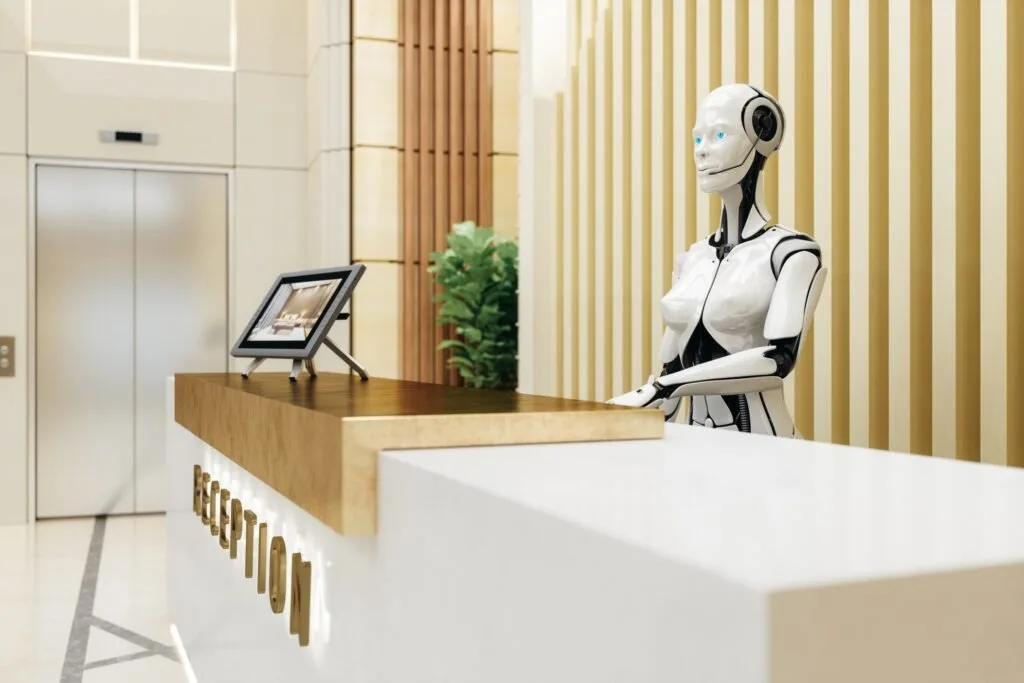
Artificial intelligence in hospitality is usually discussed as a gadget: a chatbot on the website, an automated reply to reviews, a tool that writes social posts. That framing undersells it badly. Properly deployed, hotel AI is a digital decision-making mechanism for the whole business – and marketing AI is the part of it that turns visibility into measurable return. This article sets out what each one does, how they fit together, and why the hotels investing now are shaping the market rather than following it.
TL;DR
- Hotel AI is not one automation tool. It supports every department – revenue, HR, F&B, finance, guest experience – with data, forecasts and strategic recommendations, so the property runs strategically rather than reactively.
- Marketing AI converts digital presence into performance: audience understanding, targeted content, campaign optimisation and better conversion, reaching the right guest on the right channel at the right time.
- The real advantage comes from an integrated ecosystem in which management roles, marketing, guest experience and staff training share one strategic picture – AI that strengthens people rather than replacing them.
What hotel AI is – and why it is changing hospitality
Hotel AI works as a digital decision-making mechanism for the property. It is not confined to a single automation tool; it can support different departments of the business with data, forecasts and strategic proposals.
The range is wide. At the guest-facing end sit the AI concierge and guest-experience automation – answering questions, handling requests and personalising the stay. Behind the scenes sit AI roles in revenue, HR, F&B and finance, each working from the same operational data to give department heads faster, more accurate and more effective support.
How AI helps a hotel
AI for hotels can deliver:
- Data-based forecasts – demand, pick-up, cancellations, staffing needs.
- Recommendations to grow revenue – rate, availability, channel mix and upsell opportunities.
- Optimised operational processes – from housekeeping sequencing to purchasing.
- Lower cost and fewer human errors – particularly in repetitive reconciliation and reporting work.
- A better guest experience – faster answers, more relevant offers, fewer service gaps.
- Support for strategic decisions – scenario analysis and clear options for management.
The result is a smart hotel that does not operate reactively, but strategically. Instead of discovering in the month-end P&L that occupancy fell and payroll did not, the manager is told in week one – with a recommended adjustment attached.
Marketing AI in tourism: from visibility to performance
Marketing AI in tourism transforms digital promotion into measurable performance. It is no longer enough for a hotel simply to be present on social media or in the search engines. It needs strategy, data analysis and continuous optimisation – and those are precisely the tasks AI performs well at scale.
Using artificial intelligence, hotels can understand their audience better, create more targeted content and improve the performance of their advertising. That matters commercially because every guest won through the hotel’s own channels is a direct booking – revenue that does not carry an OTA commission and a guest relationship the hotel owns.
Applications of marketing AI for hotels
Marketing AI can support:
- Social media strategy – what to publish, when, and for which audience.
- Google Ads optimisation – bids, keywords and audiences tuned continuously against actual bookings.
- Content and blog automation – producing and scheduling material that answers what prospective guests are searching for.
- Customer-journey analysis – understanding the path from first search to booking and where guests drop out.
- Personalised campaigns – offers matched to segment, season and past behaviour.
- Conversion-rate improvement – testing and refining the booking engine, landing pages and offers.
In this way a hotel can reach the right guest, on the right channel, at the right moment – and can measure the return on every euro spent rather than hoping the campaign worked.
Hotel AI and marketing AI: how they differ, and where they meet
The two are often confused, because both are “AI for hotels”. They work on different sides of the business and are judged by different numbers.
| Hotel AI | Marketing AI | |
|---|---|---|
| Primary question | How should the hotel operate and price to maximise profit? | How do we reach and convert the right guest at the right cost? |
| Core data | PMS, channel manager, payroll, accounting, F&B systems | Website analytics, campaign platforms, booking-engine funnel, reviews |
| Main users | GM, revenue manager, financial controller, department heads | Marketing manager, revenue manager, owner |
| Measured in | Occupancy, ADR, RevPAR, CPAR, GOP, GOPPAR | Cost per booking, direct-booking share, conversion rate, return on ad spend |
Where they meet is the direct channel. Hotel AI identifies the dates and segments where the property needs demand and at what rate it should be sold; marketing AI goes and finds that demand and brings it to the booking engine. Without the link, marketing spends budget filling dates that would have sold anyway, and revenue management discounts dates that a targeted campaign could have filled at rate.
What an integrated hotel and marketing AI ecosystem looks like
The step-change comes when these capabilities stop being separate tools and become a modular ecosystem designed for hotels, tourism businesses and brands that want to move into the next era of hospitality management.
Such an ecosystem is not a single product. It combines hotel management, marketing automation, guest experience and staff training through AI roles and intelligent functions that share the same data. In practice it brings together:
| Component | What it does for the hotel |
|---|---|
| AI hotel-management roles for GM, CEO, Revenue, HR, F&B and Finance | Department-level analysis and recommendations grounded in live operating data |
| AI marketing hub with performance and automation tools | Campaign optimisation, content and conversion work tied to actual bookings |
| AI concierge and guest experience | Faster, personalised guest service before, during and after the stay |
| AI training and eLearning for hotel teams | Continuous upskilling so staff can act on what the systems recommend |
| A unified strategic view for management | One picture of revenue, cost, marketing and guest experience |
All the components work together, giving the hotel executive intelligence, better control and a more complete view of its operation. The revenue role sees the same forecast the HR role uses to plan staffing; the marketing hub knows which dates need demand; the finance role sees the resulting GOP. None of that is possible when each function buys its own disconnected tool.
Why artificial intelligence is now the only way forward for hotels
Hospitality is becoming more demanding on every side. Guests expect speed, personalisation and a flawless experience. Owners and managers need better control of cost, staff and revenue. The margin for error – and the margin for profit – is thinner than it was.
Artificial intelligence in tourism answers these needs with substantive advantages rather than novelty.
Key benefits of hotel AI
By adopting hotel AI solutions, a property can achieve:
- Faster and more accurate decisions, because the analysis is done before the meeting, not during it.
- Higher occupancy and revenue, through better forecasting, pricing and channel management.
- A better customer experience, with consistent service and relevant offers.
- More effective staff training, delivered continuously rather than once a season.
- Improved operational organisation, with fewer gaps between departments.
- A strong competitive advantage over properties still managing on spreadsheets and instinct.
AI does not replace people. It strengthens them, gives them better tools and helps them focus on the work that genuinely needs a human – the guest in front of them, the supplier negotiation, the judgement call.
What AI will not do on its own
Three conditions decide whether any of this delivers:
- Data quality. AI reasons from the PMS, the channel manager and the accounts. If rate codes are inconsistent, costs are booked late or departments are not separated in the P&L, the recommendations inherit every error.
- Human judgement. The system proposes; a manager decides. A recommended rate change still needs someone who knows that a wedding party arrives on Friday or that the neighbouring hotel has closed for renovation.
- Guest trust. Personalisation must stay on the right side of privacy. Guests welcome a relevant offer; they do not welcome the sense of being tracked.
The smart hotel of the future starts today
Hotels that invest in artificial intelligence now gain a lead. They do not simply wait for the market to change; they adapt faster, anticipate trends and create more efficient experiences for their guests.
A smart hotel is not merely a technologically advanced hotel. It is a business that uses data, automation and AI tools to operate with strategy, consistency and higher performance. The technology is the means; the disciplined, evidence-based operation is the point.
Where to begin
For most independent and mid-sized hotels the practical starting sequence is:
- Get the data flowing. Connect the PMS, channel manager, booking engine and accounting so that revenue and cost sit in one place.
- Put live profitability in front of management. GOP, GOPPAR, CPAR and channel contribution, updated daily rather than monthly.
- Add AI roles where the money is. Revenue and marketing first – pricing, availability and direct-booking campaigns – then HR and F&B.
- Train the team to act on it. Recommendations only create value when someone executes them.
Conclusion
Hotel AI and marketing AI are now fundamental pillars of modern hospitality management. Artificial intelligence in tourism gives hotels the ability to operate more intelligently, take better decisions and offer guests a superior experience.
The hotels investing today in integrated AI ecosystems are not merely following the future of hospitality. They are shaping it.
How Hotelia360 helps
Hotelia360 is built on exactly this integrated model. Our AI agents work as department-level roles across revenue, cost control, marketing and operations, drawing on live data from your PMS and channel manager, while our BI dashboards give owners and managers one view of occupancy, RevPAR, GOP and direct-booking performance. From channel management and direct-booking strategy to live profitability monitoring, we help hotels move from reactive management to strategic, AI-supported operation.
Published by Hotelia360, Heraklion. Also available in Greek.