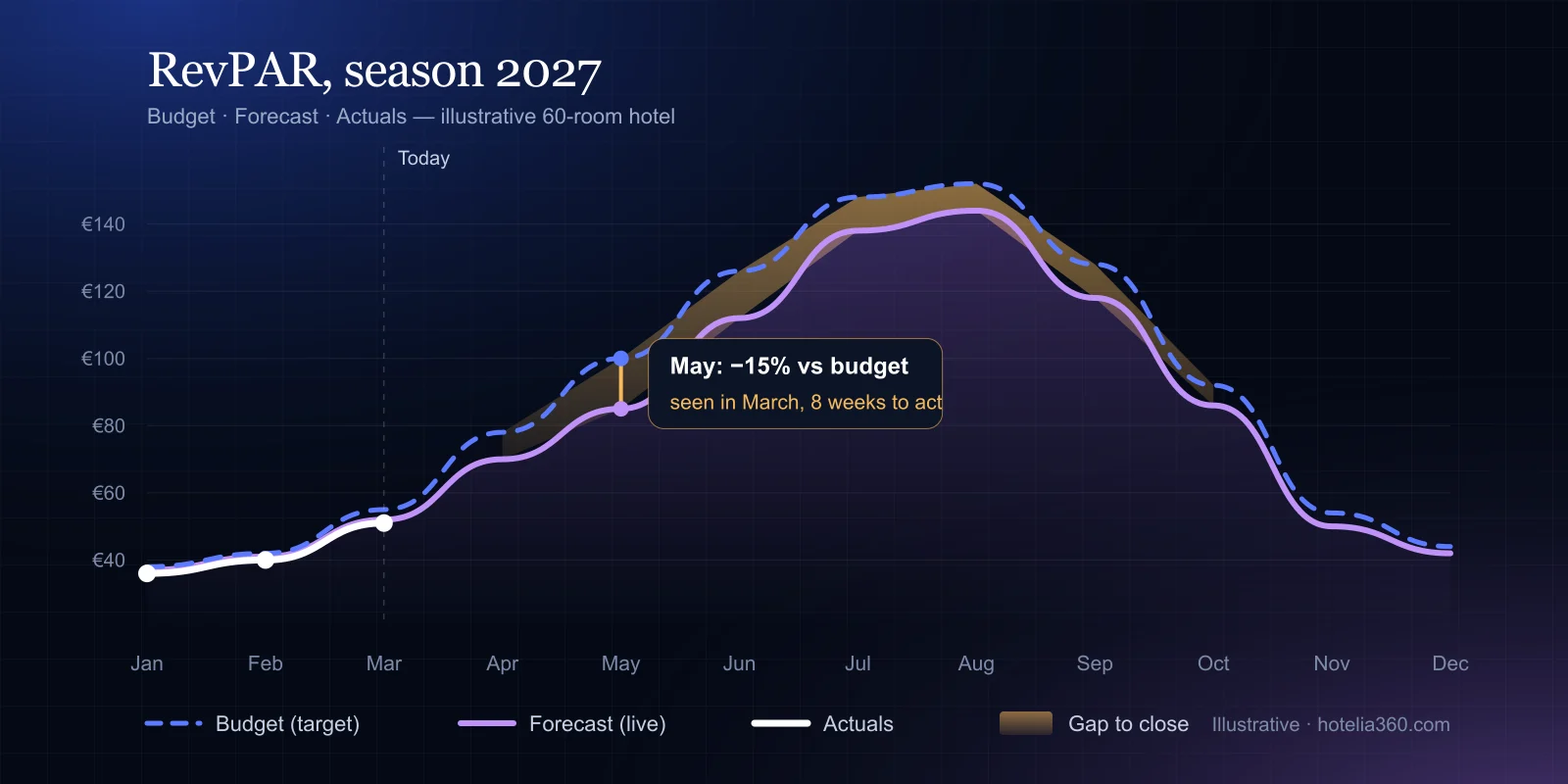
Every successful hotel season starts months before the first guest arrives. It starts with two planning tools that are often confused: the budget and the forecast. Used together, they tell you where you want to go and where you are actually heading, so you can correct course while there is still time to act.
TL;DR
- The budget is your annual financial plan: targets for revenue, costs and profit, set before the season.
- The forecast is a live, data-driven prediction of where the season is really heading, updated as bookings, cancellations and market conditions change.
- The two only work as a pair. Compare budget, forecast and actuals every month, and use the gaps to adjust pricing, marketing and staffing early.
What a hotel budget is: your battle plan
The budget is the annual financial plan of the property. It sets out expectations for:
- Revenue, by channel and by department
- Costs, both fixed and variable
- Profitability targets such as GOP and EBITDA
It is the road map: it shows where you want to arrive. But a budget is built on estimates and targets, not on current data. It is a statement of intent made before the season starts, and the market does not always read it.
For example, a 2027 budget might assume 80% occupancy and an ADR of €125 in May. That delivers a RevPAR of €100, and that RevPAR in turn drives the GOP target for the month.
What a hotel forecast is: your radar
A forecast is a realistic prediction of how the period will actually turn out, built on live data. It is updated continuously from:
- Booking pace and pickup trends
- Cancellations and no-shows
- Competitor rates and market demand
- Seasonality, events and other external factors
The forecast does not say where you want to go. It says where you are going right now. That is what makes it useful: it lets you correct course before you drift too far from the target.
Budget vs forecast, side by side
Think of the budget as the compass and the forecast as the GPS. The first sets the destination and the route; the second keeps you on it.
| Tool | Purpose | Frequency | Based on |
|---|---|---|---|
| Budget | Setting targets | Annually, before the season | Estimates and goals |
| Forecast | Adjusting strategy | Monthly or weekly | Real, current data |
| Actuals | Measuring results | Daily and month-end | What actually happened |
A worked example: when May slips
Take an illustrative 60-room hotel. The budget assumes May RevPAR of €100, from 80% occupancy at an ADR of €125. In March, the booking pace and competitor rates say otherwise: the forecast now points to 74% occupancy at an ADR of about €115, or a RevPAR of roughly €85.
That is a 15% gap. Across the 1,860 available room nights in May (60 rooms × 31 days), it is around €27,900 of rooms revenue that the budget expects and the forecast does not. Without the forecast, the hotel would find out at month-end. With it, there are still weeks to respond:
- Review rates and restrictions for the weak dates, rather than discounting across the board (see the case for a flexible pricing policy).
- Launch a targeted direct-booking offer or shift channel mix before the gap hardens.
- Adjust rosters, purchasing and F&B orders to the demand you will really have.
The numbers in this example are illustrative, but the mechanism is real: the earlier the gap is visible, the cheaper it is to close.
The benefits of good forecasting
- You know when to step up marketing and when to hold back.
- You set staffing levels and supplier orders against real demand, which protects cost lines such as operating expenses.
- You keep control of cash flow and avoid over-investing ahead of demand.
- You improve ADR and RevPAR through a flexible, evidence-based pricing strategy.
A well-maintained forecast turns data into action. It lowers risk and makes profit more predictable, which is ultimately what GOPPAR and your owners care about.
How to build a dynamic planning system
- Connect your data. Link your PMS, channel manager and CRM so forecasts run on real-time information, not on last month’s export.
- Hold a monthly forecast meeting. Bring revenue and operations together to agree the numbers and the actions behind them.
- Compare three views every month. Budget vs forecast vs actuals. The budget shows the plan, the forecast shows the trajectory and actuals show the truth.
- Act on the gaps. Update pricing, staffing and promotions based on what the comparison reveals, and record why you changed course.
The key point: a forecast is not an Excel file. It is a process of continuous improvement, and its value comes from the decisions it triggers. It also feeds directly into the reporting discipline described in our guide to hotel profitability reporting.
Conclusion
Your budget shows where you want to go. Your forecast shows where you are really heading. Only when you combine the two can you manage the season with confidence, flexibility and profitability.
Success in a hotel season is not luck. It is preparation that keeps adjusting.
How Hotelia360 helps
Hotelia360’s live profitability monitoring puts budget, forecast and actuals in one view, so a widening gap is visible the week it opens rather than at month-end. Our AI agents work from your PMS data to flag pace and pickup changes and to recommend pricing and staffing responses, and our BI reporting gives owners and managers a single, consistent picture of the season across RevPAR, CPAR and GOPPAR.
Published by Hotelia360, Heraklion.