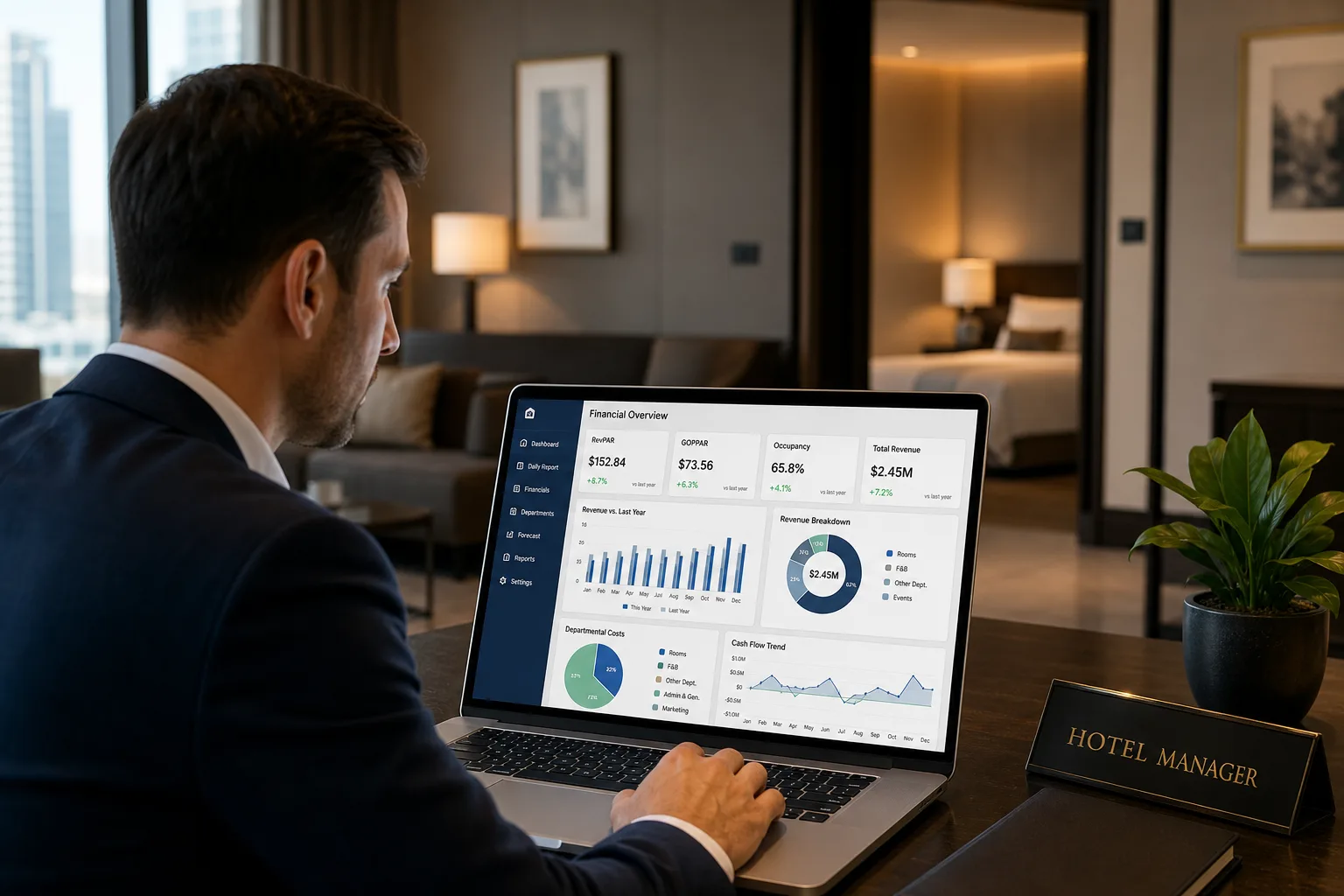
A hotel’s financial success does not depend only on bookings, occupancy or RevPAR. It depends, above all, on how you interpret, monitor and act on the financial data already available to you. Systematic tracking of the right reports – not just the statutory accounts – is what separates a genuinely profitable hotel from a hotel that is merely full.
TL;DR
- Three reports carry most of the weight: a departmental P&L, a combined RevPAR / CPAR / GOPPAR view, and a cash flow report. Together they connect revenue, cost and liquidity.
- RevPAR alone can flatter a hotel. A property with RevPAR of €80 and CPAR of €45 leaves €35 of GOPPAR – and that, not the top line, is what you manage.
- Reporting only works as a routine. Ten minutes of daily review of occupancy, revenue by department, key costs, variance to budget and expected receipts prevents most month-end surprises.
Why your hotel needs profitability reporting
Profitability reports are not an accounting formality. They are a core strategic management tool for any owner, hotel manager, financial controller or revenue manager who wants to make better decisions.
With an organised reporting system you can:
- Spot trends in demand, occupancy and revenue before they show up in results.
- Identify which sales channels are genuinely the most productive – net of commission, not gross.
- Understand which costs are eroding operating profit.
- Compare actual performance against budget and forecast.
- Make evidence-based decisions on pricing, investment and operations.
In modern hotel management it is not enough to know how many rooms you sold. You need to know what profit those sales left behind.
The three financial reports you must track
For a clear picture of financial performance, you need reports that link revenue, costs and liquidity. Three do the job.
1. The Profit & Loss report
The Profit & Loss report – the P&L – is the foundation of a hotel’s financial analysis. It presents revenue, operating expenses and the final result, profit or loss, for a given period.
A proper hotel P&L should never stop at the total for the property. It has to be broken down by department:
- Rooms Division
- Food & Beverage
- Spa or wellness
- Events and conferences
- Other revenue and support departments
Only at this level can you see which departments are running efficiently and which need immediate intervention. A healthy rooms margin can easily mask an F&B outlet that loses money on every cover, and a single blended figure will never tell you.
Tip: do not wait for month-end to read the P&L. Weekly monitoring lets you correct deviations before they turn into a significant loss of profitability. A cost overrun spotted in week one is a conversation; the same overrun discovered on the 5th of the following month is a write-off.
2. The RevPAR, CPAR and GOPPAR report
The report that combines RevPAR, CPAR and GOPPAR shows the hotel’s true operating performance. It looks not only at how much you sell, but at how efficiently you operate.
| Metric | What it measures | Formula |
|---|---|---|
| RevPAR | Revenue generated by each available room | Rooms revenue ÷ available rooms |
| CPAR | Cost carried by each available room | Operating cost ÷ available rooms |
| GOPPAR | Operating profit left by each available room | GOP ÷ available rooms (≈ RevPAR − CPAR) |
RevPAR is an important indicator, but on its own it is not enough. A hotel can have a high RevPAR and low profitability if its operating costs are inflated.
Example: if a hotel has RevPAR of €80 and CPAR of €45, its GOPPAR is €35. Every available room leaves €35 of operating profit before non-operating charges such as rent, interest, depreciation and tax.
Read together, these three figures tell management which lever matters most for the next period. If RevPAR is strong but GOPPAR is thin, the problem is cost, and another rate increase will not fix it. If CPAR is under control but GOPPAR is still low, the issue is revenue – rate, occupancy or mix. Correctly analysing the three indicators is how you decide whether raising prices, improving occupancy or cutting cost is the right strategy.
3. The cash flow report
The cash flow report shows the hotel’s liquidity: how much money is coming into the business and how much is going out.
Many hotels look profitable in their financial results yet struggle with liquidity in day-to-day operations. This happens when receipts are delayed or when obligations fall due earlier than the revenue that is supposed to cover them – a very familiar pattern in seasonal destinations where costs start months before the first arrival.
A hotel with a good GOP but weak cash flow should examine:
- Late payments from OTAs or partners.
- High deposits paid to suppliers.
- Large receivable balances from travel agencies and tour operators.
- Mismatches between reservations, invoicing and actual receipts.
- Elevated operating expenses during low-liquidity periods.
Cash flow is critical because it shows whether the hotel can cover payroll, suppliers, operating expenses and investment without strain. Profit is an opinion about a period; cash is what pays the staff on the 30th.
Reading the three reports together
Each report answers a different question, and the diagnosis usually comes from the combination rather than from any one of them.
| What you see | What it usually means | Where to look next |
|---|---|---|
| Strong RevPAR, thin GOPPAR | Revenue is fine; cost is the problem | Departmental P&L – labour, CoGS, energy by department |
| Healthy GOP, weak cash flow | Profit is being earned but not collected | Cash flow report – OTA and agency receivables, supplier deposits |
| Rooms margin healthy, total GOP falling | A non-rooms department is losing money | P&L by department – F&B, spa, events |
| GOPPAR flat while occupancy rises | Extra rooms are being sold at or below cost to serve | RevPAR / CPAR report – rate, channel mix, variable cost per occupied room |
| Actuals on budget, forecast slipping | The problem is ahead of you, not behind | Pick-up and pace by period; adjust rate and cost plans now |
This is why a single headline number is never enough. A full hotel with a strong RevPAR can still be sliding towards a cash crisis, and only the three reports read side by side will show it in time.
Embedding financial reports in daily operations
A modern PMS, ERP or dedicated hotel reporting system can consolidate and display the core financial reports automatically. The important thing is not merely that the data exists, but that it is reviewed consistently.
A practical approach is to have reports delivered to management daily or weekly, depending on the size and needs of the hotel. On a daily basis, the hotel manager or financial controller should check:
| Daily check | Why it matters |
|---|---|
| Occupancy and available rooms | Sets the denominator for every per-room metric and the staffing plan |
| Daily revenue by department | Catches under-performing outlets immediately |
| Key operating expenses | Payroll, energy, CoGS – the lines that move GOP |
| Variances from budget and forecast | The earliest possible warning that the plan is off |
| Revenue by sales channel | Net contribution of direct bookings vs. OTAs vs. agencies |
| Liquidity and expected receipts | Whether the next payroll and supplier run are covered |
Even 10 minutes of daily analysis can prevent significant losses at the end of the month or the season. A small deviation in cost, occupancy or ADR compounds quickly into a large difference in the final result.
What is the real value of hotel profitability reporting?
Profitability reporting lets management see the true picture of the hotel – based on figures, trends and comparisons rather than assumptions.
With the right reports you can answer the questions that actually decide the year:
- Which department has the highest profit margin?
- Which booking channel delivers the best net return?
- Where is cost rising without a matching rise in revenue?
- When should rates go up – or down?
- Which period needs stronger revenue management?
- Which decisions must be taken now, before they affect the bottom line?
The value is not in recording the numbers. It is in interpreting them and in the action that follows.
Conclusion
Profitability reports are your hotel’s GPS. Without them, management is driving blind. With them, you know exactly where the business stands and which steps will improve its performance.
Tracking the P&L, GOPPAR, CPAR, RevPAR and cash flow helps a hotel forecast, correct and plan strategically. The difference between a full hotel and a profitable hotel lies in knowing the numbers.
Frequently asked questions
What is profitability reporting in a hotel?
Profitability reporting is the process of monitoring and analysing financial data – revenue, costs, operating profit, cash flow and performance by department – so that management can see where profit is made and lost.
Why is RevPAR not enough on its own?
RevPAR shows revenue per available room but ignores the cost of operating. That is why it must be paired with CPAR and GOPPAR, which show what each room costs and what it actually leaves as operating profit.
Which report matters most for profitability?
The P&L report gives the overall picture, while GOPPAR is the best single indicator of true operating performance per available room. In practice you need both.
How often should financial reports be reviewed?
Key indicators should ideally be reviewed daily. Detailed reports such as the P&L, cash flow and budget variance should be examined at least weekly or monthly.
How does a cash flow report help a hotel?
It shows whether the hotel has enough liquidity to cover payroll, suppliers, operating expenses and investment needs – regardless of what the P&L says about profit.
How Hotelia360 helps
Hotelia360 builds exactly this reporting layer for hotels: live BI dashboards that pull revenue from the PMS and channel manager, cost from accounting and payroll, and present P&L by department, RevPAR, CPAR, GOPPAR and cash position in one place. Our AI agents monitor the figures continuously, flag variances against budget and forecast, and tell you which lever – rate, occupancy or cost – will move profit most in the coming period.
Published by Hotelia360, Heraklion. Also available in Greek.